
Were your Romanian ancestors described as ‘peasants’? What did it mean to be a peasant?
A general term
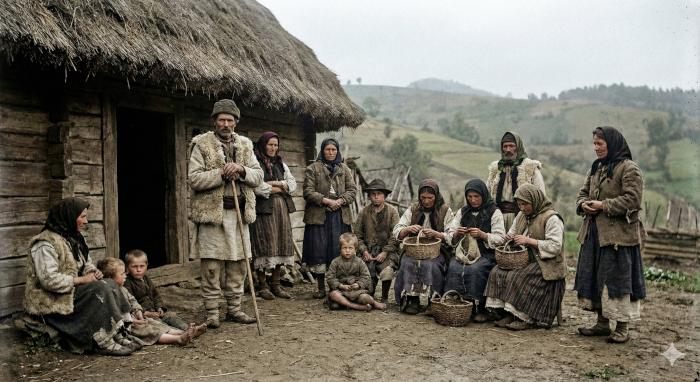
To be called a ‘peasant’ (Romanian: Țăran) referred to anyone who lived in a rural village and worked the land and/or raised animals. A peasant was not a member of the ruling class and they probably did not own the land which they worked. It’s an umbrella term as there were different types of peasants.1,2
Types of peasants
Depending on the time period and region there could be three different classes of peasant:
The serf: (Romanian: Iobag / Hungarian: Jobbágy)
- An unfree peasant. Another term might be ‘chattel slave’.3
- Depending on the time period and region a serf had few rights granted to them by their Lord (or the State). Children born to a serf were themselves serfs, a practice known as ‘Hereditary serfdom’.4,5
- Many serfs were of Romani ethnicity (Romanian: țigani)6
- A peasant could become a serf by:
- Being born to parents who were Serfs
- Being unable to pay their taxes to their Lord or State
- Selling themselves into Slavery to generate income10
- Responsible for tending a full plot of land (a “session”) owned by their lord capable of sustaining their own family through planting and harvesting crops, gardens and raising animals.11
- Some serfs worked as skilled tradespeople and domestic servants
- Were owned by their lord in that they could not without the permission of their lord:
- marry
- move from their land
- pass the use of their plot of land to their own children/family
- learn a trade
The Cottar: (Hungarian: Zsellér)
- A “Landless” Peasant
- Were responsible for tending a very small plot of land, perhaps only a house and garden which were owned by their lord
- Often poorer than peasants who were Serfs.
The Free Peasant: (Romanian: Nemeș)
- Rarely granted
- Small landowners or lesser nobility
- Depending on the time period, region or relationship with their lord a peasant could achieve this status by:
- Performing exceptional military or State service
- Paying the lord
- Receiving an official decree by the lord or the State or stipulated in the Will of a lord12
- Depending on the time period, region or relationship with their lord may have gained the right to:
- Marry without requiring permission (unless they wanted to marry a serf (slave) in which case they might have been required to become a serf themselves)13
- Move to the land of another Lord without requiring permission from their current lord
- Own a small amount of land
- pass the use of their plot of land to their own children/family
- Still required to pay tax or perform mandatory uncompensated labour (Hungarian: robot, French: corvée) for their lord in exchange
References
- Țăran, Wikipedia, https://ro.wikipedia.org/wiki/%C8%9A%C4%83ran, Viewed Dec 31, 2025 ↩︎
- Serfdom in Moldavia and Wallachia, Wikipedia, https://en.wikipedia.org/wiki/Serfdom_in_Moldavia_and_Wallachia, Viewed Dec 31, 2025 ↩︎
- Slavery in Romania, Wikipedia, https://en.wikipedia.org/wiki/Slavery_in_Romania, Viewed Dec 31, 2025 ↩︎
- Serf, Oxford Rerference, https://www.oxfordreference.com/display/10.1093/oi/authority.20110810105825743, Viewed Dec 31, 2025 ↩︎
- Serfdom in Moldavia and Wallachia, Wikipedia, https://en.wikipedia.org/wiki/Serfdom_in_Moldavia_and_Wallachia, Viewed Dec 31, 2025 ↩︎
- Slavery in Romania, Wikipedia, https://en.wikipedia.org/wiki/Slavery_in_Romania, Viewed Dec 31, 2025 ↩︎
- Slavery in Romania, Wikipedia, https://en.wikipedia.org/wiki/Slavery_in_Romania, Viewed Dec 31, 2025 ↩︎
- Slavery in Romania, Wikipedia, https://en.wikipedia.org/wiki/Slavery_in_Romania, Viewed Dec 31, 2025 ↩︎
- Slavery in Romania, Wikipedia, https://en.wikipedia.org/wiki/Slavery_in_Romania, Viewed Dec 31, 2025 ↩︎
- Slavery in Romania, Wikipedia, https://en.wikipedia.org/wiki/Slavery_in_Romania, Viewed Dec 31, 2025 ↩︎
- Serfdom in Moldavia and Wallachia, Wikipedia, https://en.wikipedia.org/wiki/Serfdom_in_Moldavia_and_Wallachia, Viewed Dec 31, 2025 ↩︎
- Slavery in Romania, Wikipedia, https://en.wikipedia.org/wiki/Slavery_in_Romania, Viewed Dec 31, 2025 ↩︎
- Slavery in Romania, Wikipedia, https://en.wikipedia.org/wiki/Slavery_in_Romania, Viewed Dec 31, 2025 ↩︎